Plan the light. Then close the ceiling.
A room-by-room briefing guide for lighting choices, controls and ceiling coordination in your Islamabad home.
Same foundations.
A brighter tomorrow.
01 / Plan the light before closing the ceiling
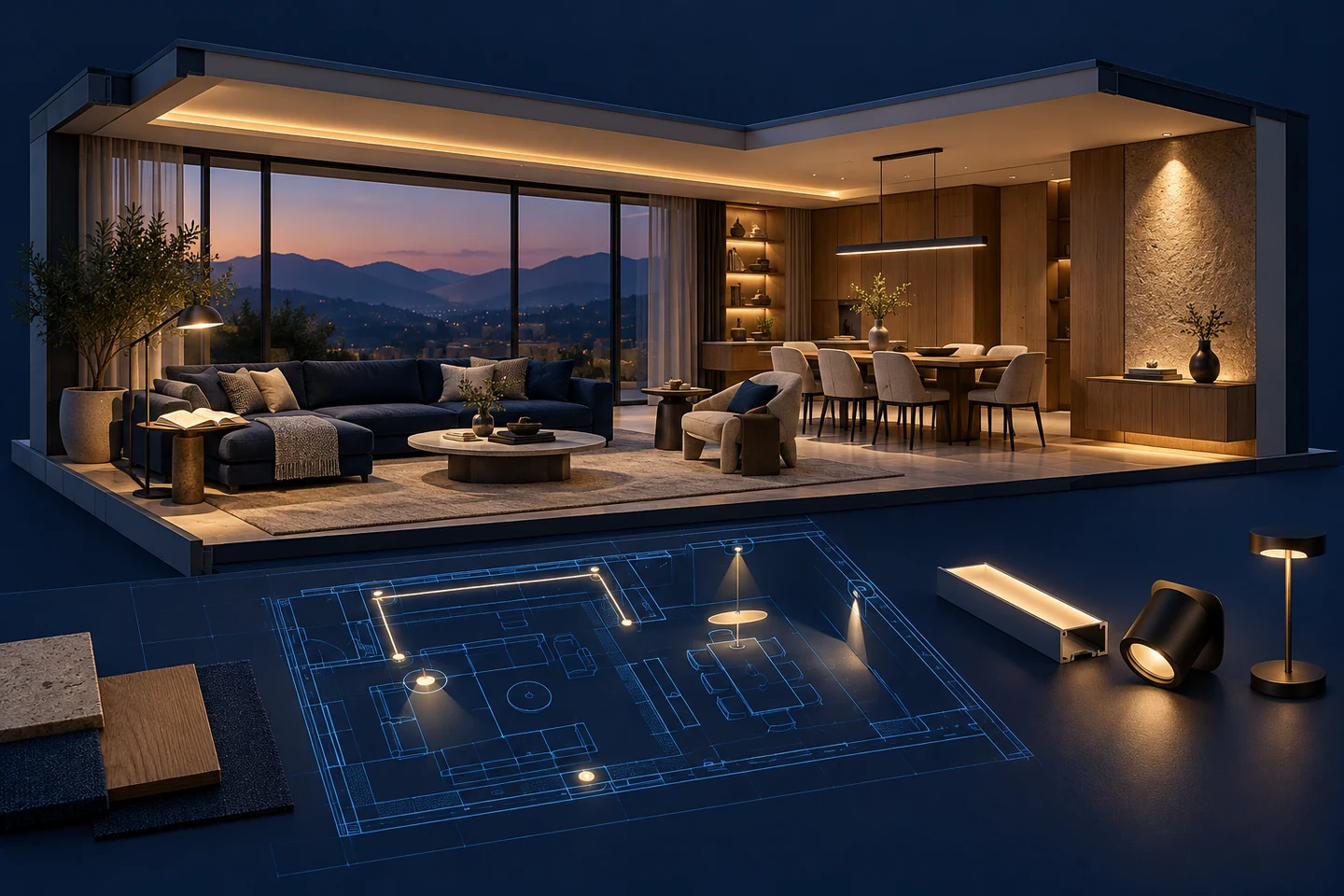
For an Islamabad home, start a lighting plan with the furniture layout and the activities in each room. Agree the fixture schedule, switching, ceiling coordination and access for maintenance before fittings are ordered or ceilings are closed. Review actual samples and product information rather than choosing every light from a catalogue photograph.
This guide is a homeowner’s briefing checklist for new construction and interior renovation. It helps you ask for coordinated decisions and records. Electrical design, installation, testing and suitability for wet or outdoor locations belong with the responsible qualified professionals.
02 / Map activities before marking light positions
Put beds, desks, dining tables, wardrobes and kitchen work surfaces onto the current floor plan. Then describe how each space will be used. A drawing room used for visiting guests, a reading corner and a desk for video calls have different needs even if their floor areas are similar.
Walk through a typical day and evening. Note where natural light enters, where you sit to read and which reflective surfaces or screens need attention. Ask the designer to review light from the positions people actually occupy, including seated eye level, rather than judging only the ceiling pattern.
Create a short room brief with the activity, desired atmosphere, controls and decisions still open. For example: dining table position confirmed; pendant sample under review; separate control requested for the feature wall. This is a hypothetical planning note, not a record of an ELEV8CONCEPTS project.
03 / Give each proposed light a purpose
Ask what each fitting contributes. General lighting helps you use the room as a whole; task lighting serves an activity such as reading or food preparation; accent lighting draws attention to a feature. Decorative fittings may serve one of those purposes while also shaping the room’s appearance.
You do not need every type in every room. Ask the designer to show how the proposed arrangement works for your priorities and budget. A repeated grid of fittings is not, on its own, a demonstration that the important surfaces will be comfortably lit.
Review the position of lamps and wall lights alongside furniture, sockets and joinery. Ask for a sample or demonstration where a bright source might be directly visible or reflected in a television, polished surface or mirror. Agree changes before a fitting position becomes a finished ceiling opening.
04 / Compare product information, not wattage alone
Lumens describe light output; watts describe electrical power. The US Department of Energy’s consumer guidance explains why wattage alone is not a reliable brightness comparison between different lighting technologies. Its guide also identifies light appearance on the Kelvin scale. These are product-comparison concepts, not a US labelling requirement being applied to a Pakistan project.
US Department of Energy: Energy Saver guide, lighting section
For each proposed fitting, ask the supplier to identify the exact model, light output, power, colour appearance and relevant product documentation. Include the driver and any required accessories in the specification. Where dimming is requested, ask for written confirmation that the proposed lamp or fitting, driver and control work together.
Avoid ordering the whole house on a colour name such as warm white alone. Review a real sample with the chosen paint, timber and fabrics, and keep its model details with the approval. Phone photographs can support the record but do not replace viewing the sample in person.
05 / Add Pakistan energy-label checks to the buying list
For an Islamabad purchase, include NEECA’s Pakistan Energy Label information in the supplier discussion. NEECA’s LED registration page explains its efficiency-rating scheme, packaging label and QR-code verification. Ask the supplier to show the applicable label and model details for the LED product being offered, and clarify anything that does not match the quotation.
NEECA: LED registration and Pakistan Energy Label information
Keep photographs of the packaging, model identification and purchase invoice. An efficiency label does not answer every design question: the selected fitting still needs to suit its intended position, controls and visual requirements. Do not use an energy rating as a substitute for an electrical installation review.
When comparing local stock with an item ordered from elsewhere, ask about the exact model available, delivery lead time, replacement parts and the written warranty process. Confirm who handles a fault in Islamabad and whether the quoted price includes the driver or other components. This guide does not quote market rates or promise a particular saving on electricity bills.
06 / Coordinate ceilings, services and access together
Request one current ceiling drawing that the interior designer, electrical team and other relevant trades can review. Ask them to check fixtures against fans, air-conditioning outlets, ceiling features, curtain pockets and access panels. Mark outstanding decisions on that drawing rather than keeping competing versions in separate chats.
Before closing the ceiling, confirm that the responsible team has agreed the installation sequence and required inspection or testing records. Ask how components that may need replacement can be reached later. An attractive finished ceiling should not leave you guessing where a concealed driver was installed.
- Current drawing revision and fixture reference for each position.
- Confirmed fittings, drivers, accessories and control types.
- Coordination decisions with fans, cooling outlets and joinery.
- Maintenance access and responsibility for completing it.
- Review or testing records required before the next stage proceeds.
07 / Decide how the room will be controlled
Describe useful situations rather than starting with an app: entering the room, reading, entertaining and moving around at night. Ask the designer which groups should switch or dim together and where controls can be reached conveniently. A clear control plan can be straightforward; smart controls are an option to assess against your needs.
Australian government lighting guidance cautions that not every control works with every bulb type, and that smart products may need compatible devices, a suitable router or additional hardware. Use that as a reason to request product-specific compatibility confirmation, not as a recommendation for a particular system.
Australian government: lighting controls and smart-light compatibility
If backup power is part of your home brief, tell the electrical designer which lighting functions you want considered. Have them specify and verify the arrangement. Do not assume a smart fitting, dimmer or driver will operate as intended simply because another light works on the same backup supply.
08 / Keep samples, quotations and decisions together
Give suppliers the same fixture schedule when requesting quotations. Separate fittings, drivers, controls, accessories, installation and any provisional work. Record exclusions and validity dates. If a substitute is proposed, update the schedule and obtain approval before ordering it.
For an overseas owner, nominate someone locally to review samples and check delivered products. Ask for a compact approval pack: annotated room plan, sample photographs, exact model details, quotation and dated decision. Clearly distinguish a sample approval from confirmation that installation and testing are complete.
At handover, retain the final fixture schedule, control instructions, supplier details, warranties and relevant completion records. Ask for a demonstration of the agreed switching and dimming functions and keep unresolved items visible until addressed. Share your drawings and current stage with ELEV8CONCEPTS for an initial project discussion; confirm location and service availability before arranging site work.
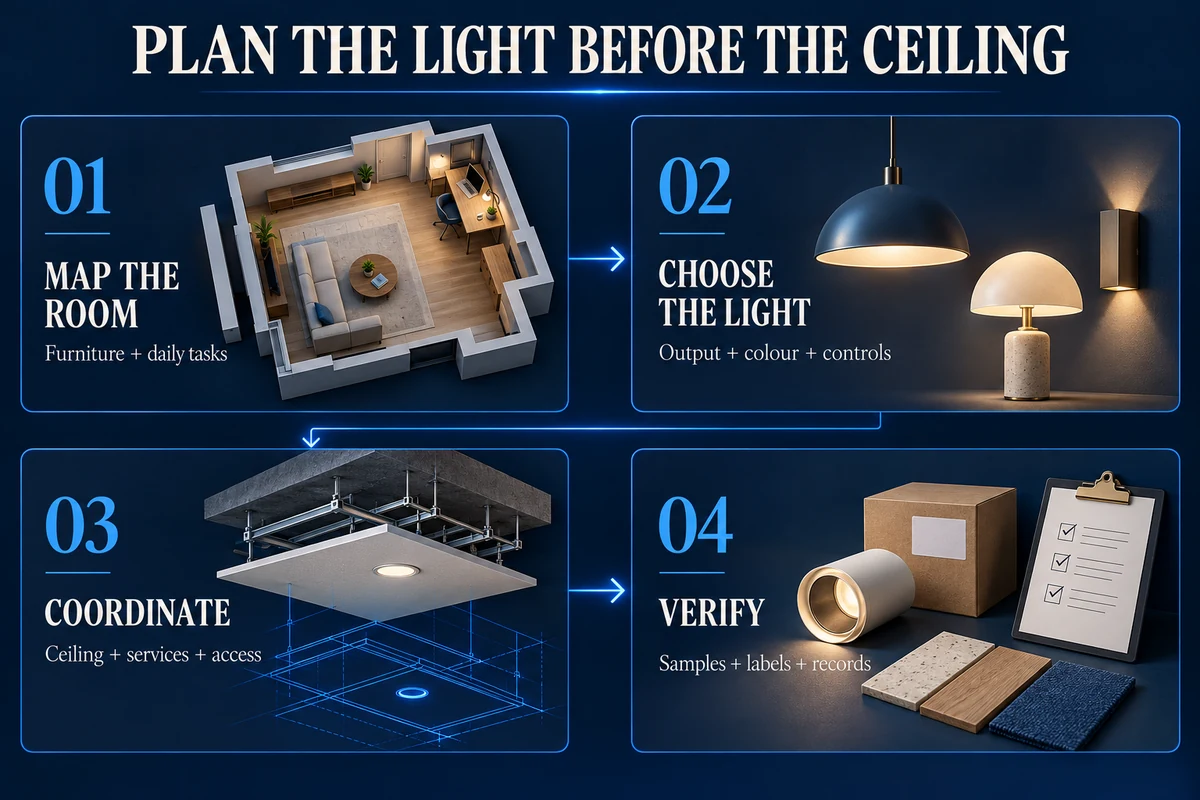
Before the ceiling closes.
Clear records help you follow decisions, review progress and keep the details that matter.
- Map — furniture, daily activities and room priorities.
- Choose — output, colour, exact models and compatible controls.
- Coordinate — ceiling positions, services and maintenance access.
- Verify — samples, applicable labels, approvals and completion records.
Common questions.
When should I plan lighting for an Islamabad home?
Start when the furniture layout and room uses are being agreed. Coordinate fittings, controls and services before products are ordered and ceilings are closed. Have qualified professionals determine the electrical design and installation requirements.
Are watts enough to compare LED brightness?
No. Compare the stated light output in lumens alongside power in watts, colour appearance and the exact model specification. Review a sample in the intended setting rather than choosing on wattage or a catalogue photograph alone.
What should I ask about Pakistan energy labels?
Ask the supplier for the applicable Pakistan Energy Label, exact product model and verification information described by NEECA. Keep packaging photographs and the invoice. The label does not replace checks for the fitting’s intended use or electrical installation.
How can an overseas owner approve lighting choices?
Nominate a local person to review samples and delivered models. Keep the room plan, fixture schedule, product details, quotation and dated approvals together. Ask for a handover demonstration and retain control instructions, warranties and completion records.